
Do the two systems agree?
Find out every day.
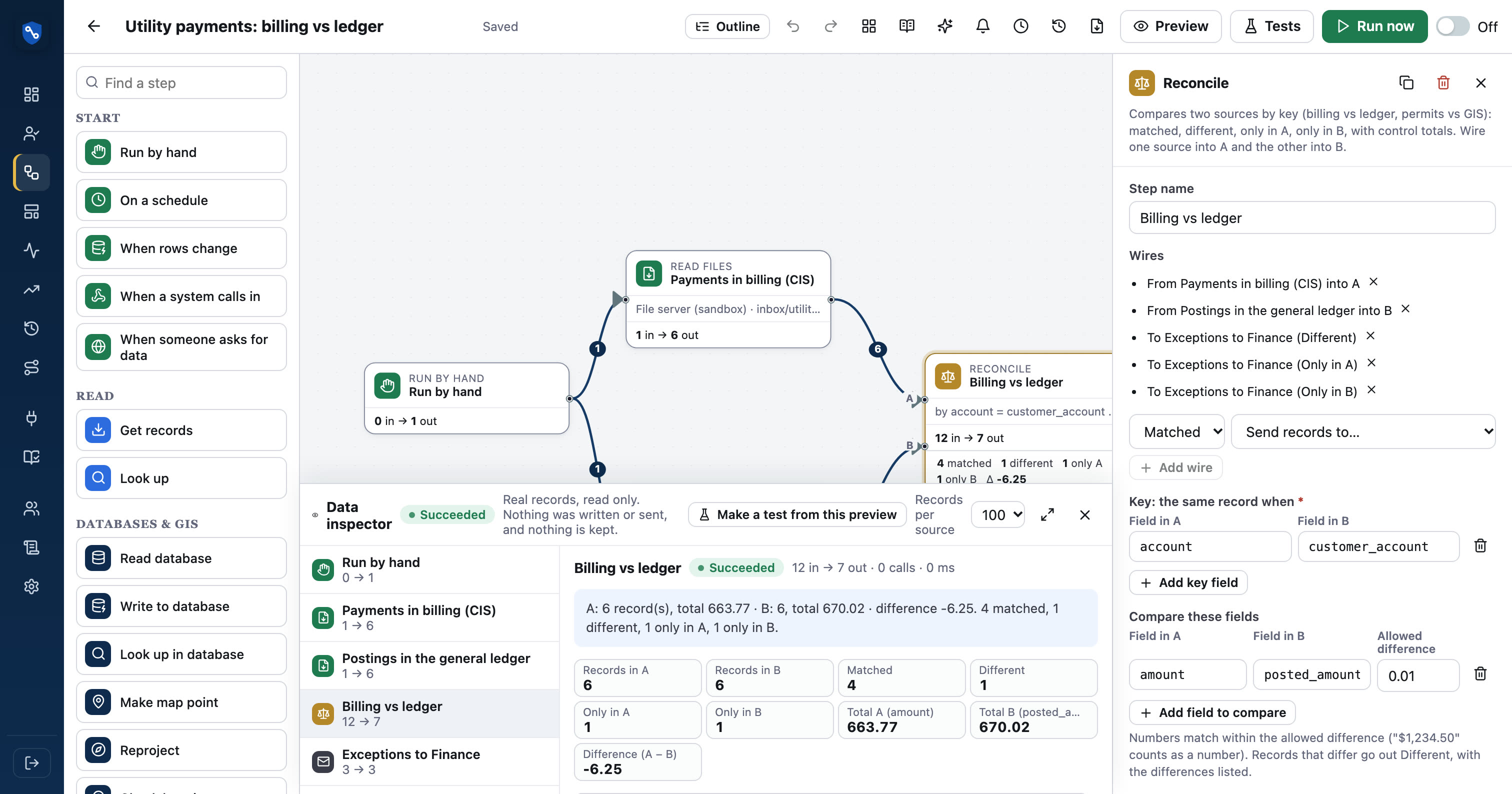
Reconcile matches records from two systems by key and sorts them into Matched, Different, Only in A and Only in B, with control totals on both sides. It's the daily check auditors ask for between utility billing, the general ledger, payment processors and the bank.
| Billing (A) | Ledger (B) | |
|---|---|---|
| Records | 6 | 6 |
| Amount | $1,042.75 | $1,049.00 |
| Difference | −$6.25 |
| output | records |
|---|---|
| Matched | 4 |
| Different | 1 · 132.50 vs 132.05 |
| Only in billing | 1 |
| Only in ledger | 1 |
Two systems, one daily check
- 01Read ABilling, payments, permits…
- 02Read BThe ledger, the bank, the GIS layer
- 03MatchBy one or more keys, with tolerance
- 04TotalCounts and sums on each side
- 05ActEmail exceptions, open tickets, or fix
Matched, Different, Only in A, Only in B.
Each record lands where it belongs, ready for the next step. Different records carry a plain list of which fields disagree and both values, so Finance can see at a glance that 132.50 was posted as 132.05.
- Keys can ignore case, spaces and leading zeros
- Numeric tolerance for rounding
- Amounts like $1,234.50 and (12.00) read as numbers
The numbers an auditor wants, every run.
Each run keeps record counts and the sum of an amount field on both sides, plus the difference and any repeated keys. They show on the canvas, in the data inspector and in run history. The records themselves are never kept.
- Totals in run history
- Repeated keys flagged
- Join step for lookups between two sources
See it in real flows.
Utility billing vs general ledger daily balance check
Every morning, compares each day's payment total in utility billing with the cash receipts journal entry in Munis. Days that don't match, or have no…
SFTP server → Utility billing (CIS)Daily payment file from Paymentus posts to utility billing
Every weekday morning, reads Paymentus's payment file from the SFTP folder, keeps accepted payments, checks each account exists in utility billing,…
Questions, answered
What can I reconcile?
Any two sources SentraBridge can read: APIs, databases and files. Common pairs are utility billing and the general ledger, a payment processor's file and billing, the bank's BAI2 file and cash receipts, and permits against a GIS layer.
Are the records stored for the audit?
No. Run history keeps counts, totals and record IDs. The details of what didn't match go wherever you send them, such as an email to Finance or a ticket.
Keep exploring
See your own systems connected.
We'll set up a workspace with your systems in a sandbox and build your first flow with you.